Your Cart is Empty


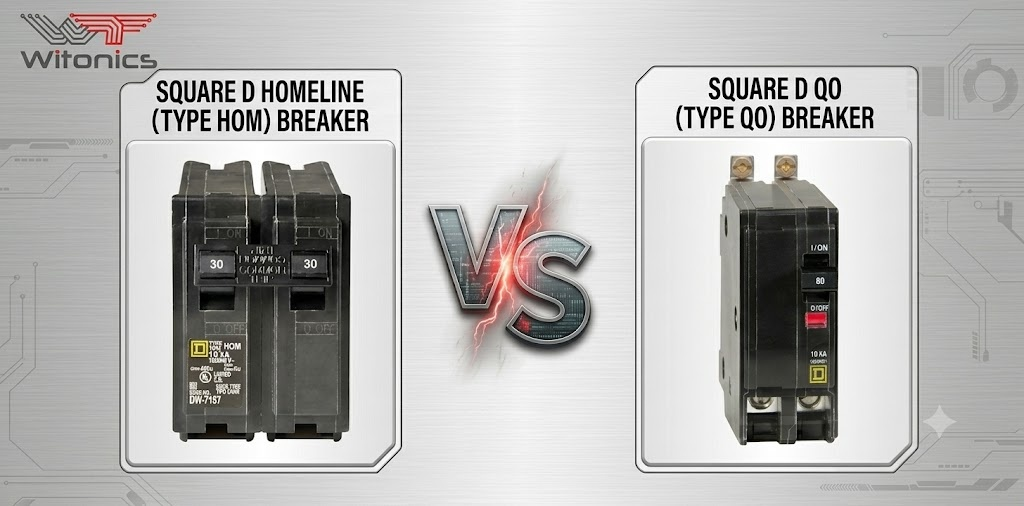

If you've opened your electrical panel to replace a breaker and seen "Homeline" or "QO" stamped on the cover, you've probably wondered if it actually matters which one you buy.
It does. These are two separate Square D product lines, and a breaker from one doesn't fit or work safely in a panel built for the other.
Here's the difference, in plain terms, and how to know which one your panel actually needs. (Still fuzzy on what a breaker even does versus a fuse? Our fuse vs. circuit breaker explainer covers the basics first.)
Homeline is Square D's budget-friendly, residential-grade line. QO (short for "Quik-Open") is the premium line, known for a faster trip response and a noticeably tighter fit and finish.
Both are made by the same company and both meet the same UL safety standards, but they are not interchangeable. A QO breaker will not snap into a Homeline panel, and a Homeline breaker will not fit a QO panel.
The most obvious difference is physical. QO breakers have a distinctive rectangular, "toggle-style" switch and a noticeably firmer, more precise click when they trip or reset. Homeline breakers have a more traditional, slimmer toggle and a softer feel.
Under the hood, QO breakers are widely considered to have a faster trip time on short circuits and overloads, which is part of why they carry a higher price. Homeline breakers meet the same UL 489 safety standard, so they're not unsafe, they're simply built to a more cost-conscious spec.
This is the part that actually matters when you're buying a replacement: your panel was built for one line or the other, and you can't mix them.
• Homeline panels accept only Homeline breakers (and a small number of Square D "CL" combination breakers designed specifically for Homeline).
• QO panels accept only QO breakers.
How to check which one you have: Look at the panel's label or the printing on the door, it will usually say "Homeline" or "QO" directly. If that's worn off, compare the shape and slot spacing of your existing breakers against the images on our circuit breakers collection. Homeline breakers are visibly narrower and have a simpler bus connection than QO.
Homeline breakers are generally the more affordable option, which is why builders use them heavily in new residential construction.
QO breakers typically cost more per unit, reflecting the tighter tolerances and faster trip mechanism.
If you're simply replacing a single failed breaker in an existing panel, the price difference won't matter much, since you have to match what's already installed anyway. It becomes relevant if you're specifying a new panel from scratch and have a genuine choice between the two lines.

If you're starting from a bare panel and can pick either line:
• Choose Homeline if you're working within a tight budget and don't need the fastest possible trip response. It's a fully code-compliant, widely available option, like our Square D Homeline 20-amp 2-pole breaker.
• Choose QO if you want the fastest trip response available in this brand family, a tighter mechanical fit, or you're matching an existing QO panel elsewhere in the building, such as a QO 30-amp breaker.
For almost everyone replacing a single breaker rather than installing a new panel, this decision has already been made for you. Match what's there.
→ Forcing a breaker that doesn't quite fit:If a breaker needs real force to snap into the bus bar, stop. It's very likely the wrong line, and forcing it can damage the panel's bus connection.
→Buying based on amperage alone:A 20-amp Homeline breaker and a 20-amp QO breaker are not interchangeable just because the amperage matches. Line compatibility comes first, amperage second.
→ Assuming all Square D breakers are the same:Square D also makes other lines beyond Homeline and QO for commercial and industrial panels. Always match by line name, not just brand.
The same "match the line, not just the brand" rule applies across manufacturers too. Eaton, GE, and Siemens each make their own distinct breaker series with their own bus connections, and none of them are interchangeable with Homeline or QO, or usually with each other.
Mixing breaker brands in one panel, even when a breaker physically seems to snap in, is a genuine safety risk rather than a minor inconvenience, since the panel's bus bar and the breaker's trip mechanism are engineered as a matched pair.
If you've inherited a panel with breakers from more than one brand, it's worth having an electrician confirm every breaker is actually rated and listed for that specific panel before you rely on it. Our guide on 5 ways to prevent electrical hazards with the right circuit breaker has more on avoiding exactly this kind of mismatch.
If your breaker is tripping repeatedly rather than needing a straight swap, it's worth ruling out the actual cause first. Our guide on why a circuit breaker keeps tripping walks through the seven most common reasons before you spend money on a replacement you might not need.
A: No. QO and Homeline breakers use different physical connections to the panel's bus bar, so a QO breaker will not snap securely into a Homeline panel, or the other way around.
A: Check the label on the panel door or cover; it's usually printed clearly. If it's worn away, compare your existing breaker's shape to reference photos, since QO breakers have a distinct rectangular toggle.
A: Both meet the same UL 489 safety standard, so Homeline isn't unsafe. QO simply has a faster measured trip response and tighter build tolerances, which is reflected in its higher price.
A: No, Homeline is generally the more affordable line, while QO costs more due to its faster trip mechanism and tighter manufacturing tolerances.
A: No. Each panel is designed for one line only. Mixing them isn't just a fit problem, it can also compromise the electrical connection and safety of the panel.
Choosing between Square D Homeline and QO is not really about which breaker is better. For a replacement, the panel already determines which one you need.
Match the breaker line, amperage, pole configuration, and other required ratings rather than choosing based on price or appearance alone.
That same approach applies when sourcing circuit breakers from Witonics. Knowing exactly what your panel requires helps you select the correct component without relying on guesswork.
If you're unsure about compatibility or the panel's condition, having a qualified electrician confirm it is a safer choice than forcing a breaker that does not fit.