Your Cart is Empty


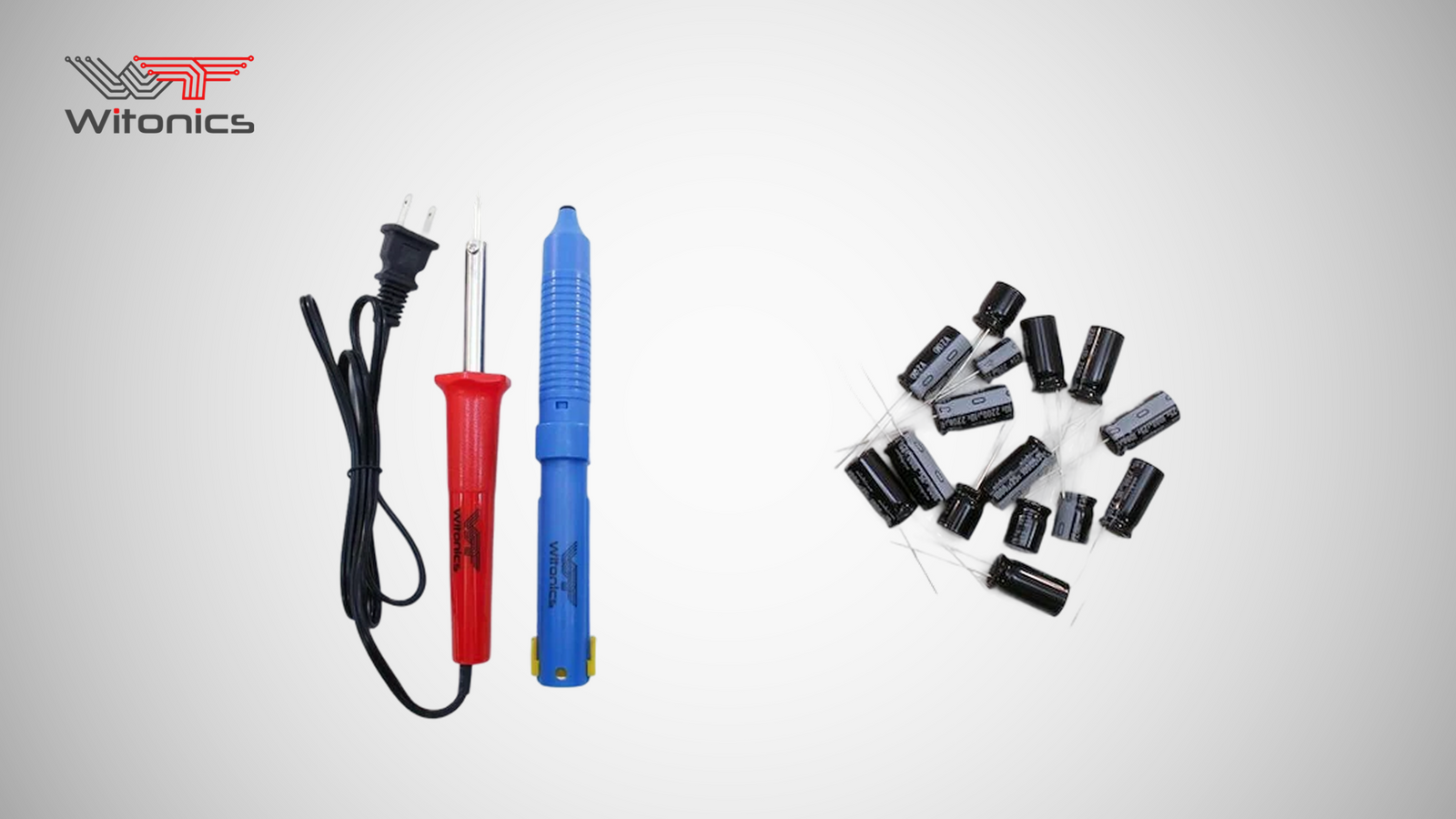

You've got the blown capacitor in one hand and the replacement in the other. They look almost identical. Same legs, similar size, roughly the same shape.
But one of them will fix your TV. The other one will either do nothing, or make things worse.
This happens to a lot of people mid-repair. Not because they picked randomly, but because nobody ever explained the difference in a way that actually sticks. Here's the version that will.
It starts with the shape
The fastest way to tell a ceramic capacitor from an electrolytic is to just look at it.
Ceramic capacitors are flat. Think of a small disc or a little rectangular wafer with two wire legs sticking out. They're usually yellow, orange, or brown. Small, simple, no markings for positive or negative, because they don't have any. Flip one around and it works exactly the same either way.
Electrolytic capacitors are the tall cylindrical ones. They stand upright, usually black or dark blue, with a light-colored stripe running down one side. That stripe is the negative leg marker. It matters more than anything else on that component.
If you're repairing a TV or monitor, the failed part is almost always an electrolytic. Ceramics sit deep in signal circuits and rarely need replacing in a standard home repair.Witonics TV capacitor repair kits come with the correct electrolytics already matched to your board, so you're not guessing which one to order.
The stripe isn't just decoration
Electrolytic capacitors are polarized. That means they have a right way and a wrong way to go in.
The stripe marks the negative leg. The longer leg is positive. When you solder one in, those need to line up with the markings on the board. Most PCBs print a small "+" symbol next to the positive hole to make it obvious.
Get it backwards and heat builds inside the capacitor almost immediately. It swells. It leaks. Sometimes it pops. And now you've got a bigger problem than the one you started with.
Take a photo of the original capacitor before you desolder it. That photo will show you exactly which way it was sitting, and save you from a very avoidable mistake.
The two numbers you need to match

Every electrolytic capacitor has two numbers printed on the body. Both of them matter.
The first is the capacitance, something like 1000µF. That's microfarads, and it tells you how much charge the capacitor stores. This needs to match the original exactly.
The second is the voltage rating, something like 16V or 25V. This is the maximum voltage the capacitor can handle safely. Match it or go higher. Never lower. A capacitor running above its rated voltage fails quickly, and usually damages whatever's around it on the way out.
Both numbers are on the original component. If it's already desoldered, check the board itself, the value is often printed right next to the solder pads on better quality boards.
For LG TVs,LG repair kits from Witonics have the capacitors already spec-matched to the boards that fail most often. Same forSamsung TV repair kits, the specs are confirmed so you're not cross-referencing datasheets at midnight.
What actually goes wrong when you use the wrong one

Wrong capacitor type, the board either won't power on or does for a second then dies. The circuit needs a specific capacitance value that the wrong component simply can't provide.
Wrong polarity, swelling, leaking, popping. Electrolyte fluid on a board that was otherwise repairable.
Wrong voltage rating, it holds for a while, then fails. Usually when you've already convinced yourself the repair worked.
None of this is rare. It happens to people who grabbed something that looked right without checking the details. Two numbers and a stripe direction is all the checking you need.
The short version before you order
• Flat disc shape → ceramic → not what you need for TV or monitor repair
• Tall cylinder with a stripe → electrolytic → this is what you need
• Match the µF value exactly
• Match or go higher on the voltage rating
• Check the board for a "+" marking to confirm which leg goes where
FAQ
Can I use a ceramic capacitor instead of an electrolytic?
No. They do completely different jobs. Electrolytic capacitors handle power filtering at capacitance levels a ceramic can't reach. Swapping them won't work.
What happens if I install an electrolytic capacitor backwards?
Heat builds up inside almost immediately. The capacitor swells, leaks, or pops. It can also damage nearby components on the board. Always check the stripe and the board markings before soldering.
Does going higher on the voltage rating cause problems?
No, going higher on voltage is safe and sometimes necessary when an exact match isn't available. The only rule is never go lower than what the circuit requires.