Your Cart is Empty


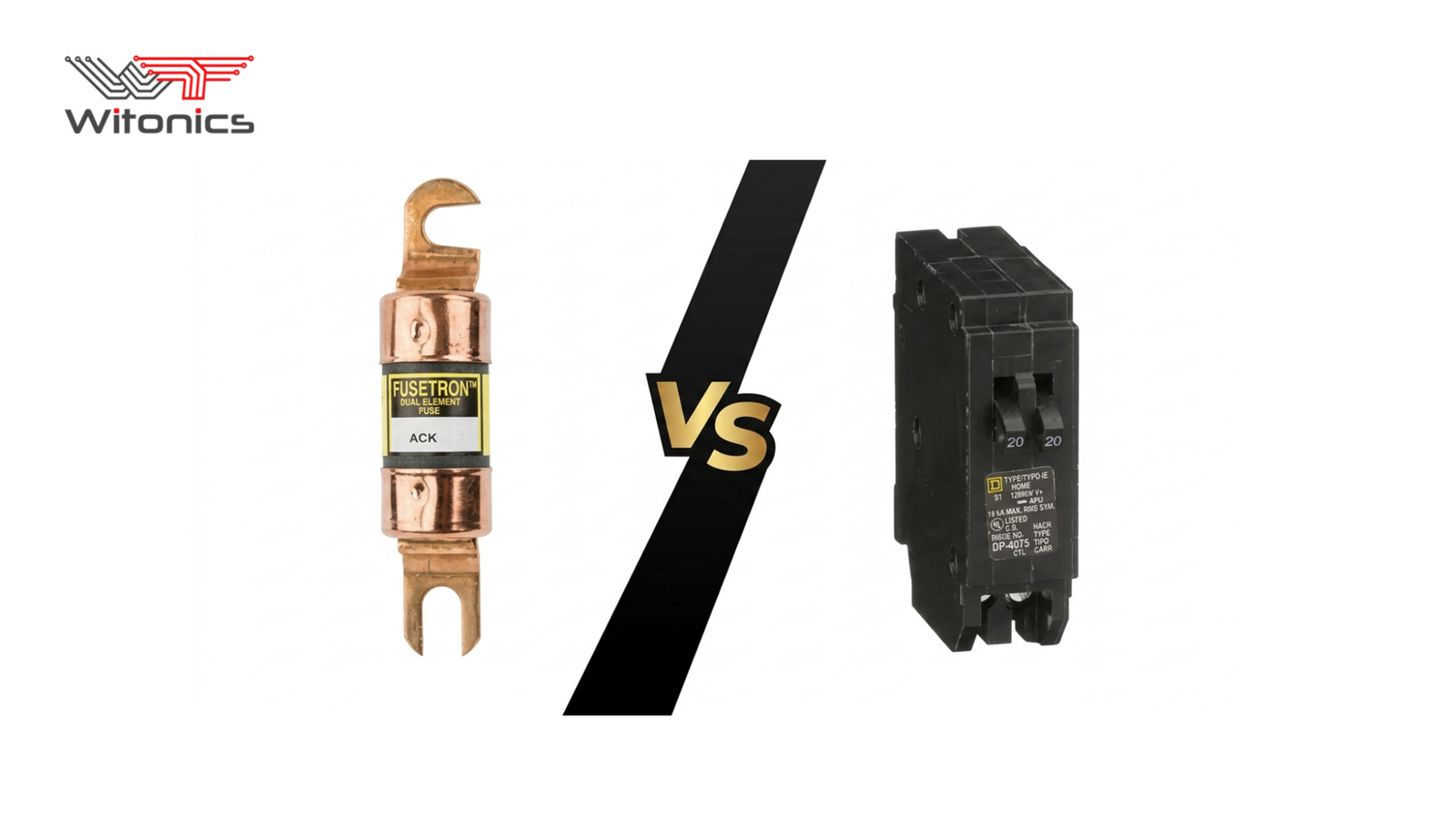

The lights in one room cut out. You head to the panel and find either a flipped breaker or a blown fuse, depending on how old your home's wiring is.
Both devices exist to do the same basic job: stop too much current before it starts a fire or damages your wiring. But they don't work the same way, they don't age the same way, and knowing the difference matters more than most homeowners realize.
Afuse is a one-time overcurrent protection device. Inside is a metal element that melts the instant current exceeds a safe level, physically breaking the circuit. Once it blows, it's done; it must be replaced before power is restored.
Fuses are simple, inexpensive, and have no moving parts to wear out, which is part of why they're still standard in many appliances, vehicles, and older homes built before breaker panels became the norm.
Acircuit breaker is a mechanical switch with a built-in trip mechanism. When current exceeds a safe threshold, an internal spring or bimetallic strip trips and flips the switch to the "off" position.
Unlike a fuse, nothing is destroyed in the process; once the fault is cleared, you simply reset the breaker by flipping it back. This convenience is the main reason modern homes are wired with breaker panels instead of fuse boxes and why most electrical codes today require them in new construction.
|
Basis |
Fuse |
Circuit Breaker |
|
Reusable? |
No, replace after each trip |
Yes, reset and reuse |
|
Response |
Very fast, no moving parts |
Slightly slower, mechanical |
|
Cost per unit |
Low |
Higher upfront |
|
Convenience |
Must keep spares on hand |
Reset instantly at the panel |
|
Common in |
Appliances, vehicles, older homes |
Modern home panels |
Because a fuse has no moving parts, it typically responds to a fault a fraction of a second faster than a mechanical breaker, since there's no internal mechanism that needs to physically move before the circuit opens. In high-precision electronics, that speed difference matters, which is why sensitive devices still rely on fast-acting fuses even inside homes that are otherwise protected by breakers.
For circuits that experience brief, harmless startup surges, a time-delay fuse avoids nuisance trips that a fast-acting fuse would cause unnecessarily. Check out our guide in which we have covered aboutThermal Fuse vs Regular Fuse: Which One Does Your Appliance Need?

Not all breakers are the same. Single-pole breakers protect one 120V circuit and are the most common type in a home panel.Eaton's QC1015 is a straightforward example: a 1-pole, 15A, 120V breaker suited to standard lighting and outlet circuits. Double-pole breakers protect 240V circuits, typically for larger appliances like electric dryers, ovens, and HVAC units;Square D's Homeline HOM230 is a 2-pole, 30A, 240V unit built for that heavier-draw appliance load.
Siemens uses its own Q-frame line, such as the Q225, a 2-pole, 25A, 240V breaker sized for Siemens panels. ABB's catalog leans toward heavier industrial and commercial work, with molded-case breakers like the XT1SU3035AYD000XXX, a 3-pole, 35A, 600V unit built for demanding three-phase loads.PCS Electrical Products covers a similar large-frame industrial niche, including the ED4K, a 225A, 240V breaker sized for heavy commercial service.Connecticut Electric rounds out the list with breakers like the UBIZ2100 ($162.98), aimed at replacing breakers in older panel types that may no longer be supported by their original manufacturer.
Getting the brand and frame right isn't optional; a breaker with the correct pole count, amperage, and voltage still won't seat or make proper contact in a panel it wasn't designed for.
Knowing which type protects which circuit in your panel makes it much easier to diagnose a real problem versus a routine trip.
For most homes, a circuit breaker panel is the more practical and safer long-term choice. It resets in seconds, doesn't require stocking replacement parts, and meets current electrical code for new construction.
Fuse boxes are also safe when properly maintained, but they age less gracefully. Corroded sockets, brittle wiring insulation, and oversized "fixes," such as inserting a higher-rated fuse than a circuit was designed for just to stop it from tripping are common in older homes that still rely on them.
If a fuse in your home keeps blowing, don't just size up to a bigger fuse. Find out why it's tripping in the first place, covered inwhy does a fuse keep blowing? common causes and simple fixes.
Breaker panels benefit from an occasional visual inspection for scorch marks, a burning smell, or a breaker that feels loose in its slot, any of which can indicate a failing panel that needs a licensed electrician's attention.
Fuse boxes need a bit more hands-on care: keeping a stock of correctly rated spare fuses on hand, checking fuse sockets periodically for corrosion, and never substituting a fuse with the wrong amperage "just to get by" until a proper replacement is available.
A: Both protect equally well when properly rated and maintained. Breakers are generally considered more convenient and less prone to unsafe workarounds like oversized fuses.
A: No. This is one of the most common causes of house fires. Always replace with the exact amperage the circuit was designed for.
A: Fuses are cheaper, smaller, and react faster, making them practical for protecting individual components rather than an entire home's wiring.
A: At a breaker panel, the switch will be in the "off" or middle position. In a fuse box, you'll usually see a discolored or broken fuse element.
A: Yes. After years of tripping and resetting, the internal mechanism can weaken. If a breaker trips immediately on reset with no clear fault, it may need replacing.
Technically yes, but this is a full electrical panel upgrade, not a weekend DIY swap. It involves rewiring the service entrance, updating grounding, and usually requires a permit and inspection from your local utility or building authority. This is one job worth leaving entirely to a licensed electrician rather than attempting yourself, given the risks involved in working on a home's main electrical feed.
Both devices protect your home the same way in principle by breaking the circuit before a fault becomes a fire. The real difference comes down to convenience, longevity, and how each ages over decades of use.
Ready to get your panel sorted? Shop the full range of circuit breakers and fuses atWitonics.