Your Cart is Empty



When a small appliance suddenly stops working, with no power, a fuse is often the first thing worth checking.
But when you open it up, you might find a component labeled "PICO fuse" instead of the fuse you expected, or a two-wire part with no glass tube at all.
These are two very different kinds of protection, and mixing them up can mean you replace the wrong part or replace a safety fuse with something that won't protect your device the same way.
Here's a simple breakdown of PICO fuses and thermal fuses, what each one actually protects against, and how to tell which one your circuit or appliance needs.

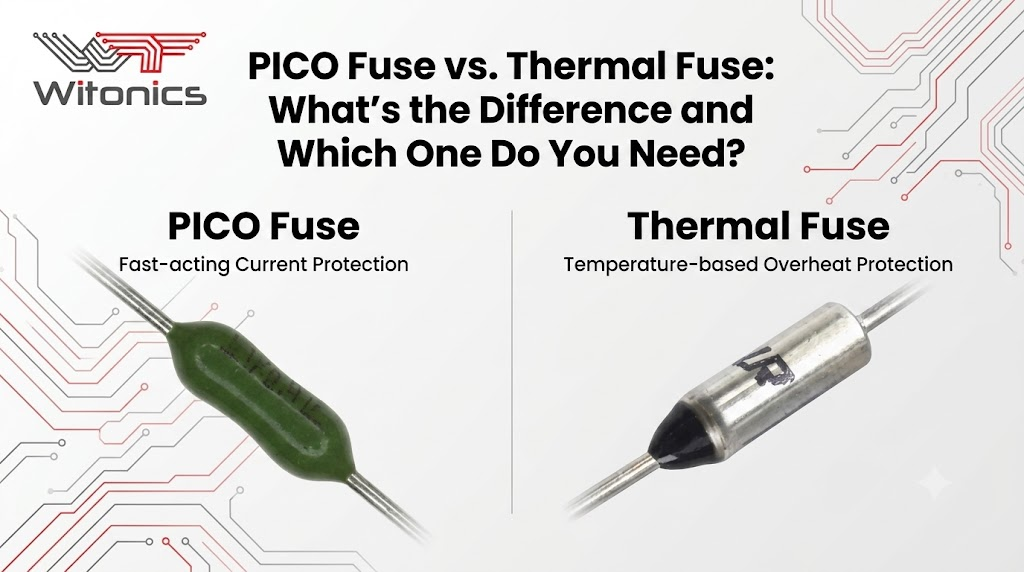
Athermal fuse is a one-time-use safety device that reacts to heat, not current. Inside it is a small pellet or spring mechanism that melts or releases at a specific temperature, usually somewhere between 72°C and 240°C depending on the part.
Once that temperature is reached, the fuse breaks the circuit permanently and cannot be reset.
You'll find thermal fuses in appliances where overheating is the real danger: hair dryers, coffee makers, toasters, dryers, and microwaves. Their whole job is to cut power before a motor or heating element gets hot enough to start a fire, even if the electrical current itself looks completely normal.

APICO fuse is a miniature, fast-acting fuse designed to protect against current, not heat. It's essentially a tiny version of the glass or ceramic fuses used elsewhere in electronics but built small enough to fit directly onto a printed circuit board (PCB) in tight spaces, think power supplies, chargers, and compact consumer electronics.
Like standard fuses, PICO fuses come in different response speeds (fast-acting or time delay) and different amperage ratings. When current exceeds the fuse's rated value, the internal wire element melts and opens the circuit, protecting the rest of the board from damage.
|
S.no. |
Thermal Fuse |
PICO Fuse |
|
What triggers it |
Heat, a specific surrounding temperature |
Current, too many amps flowing through it |
|
Doesn't respond to |
Current spikes, as long as it stays cool |
Heat, as long as current stays within rating |
|
Typical location |
Motors, heating elements, appliance housings |
Directly on a PCB, in power supplies and small electronics |
|
Common devices |
Hair dryers, toasters, dryers, microwaves |
Chargers, power adapters, compact consumer electronics |
|
What it protects against |
Fire risk from overheating components |
Board damage from excess current |
That means they're not interchangeable, even if they happen to look similar in size. Swapping a thermal fuse for a PICO fuse in a heating appliance removes your overheat protection entirely.
Swapping a PICO fuse for a thermal fuse on a circuit board won't protect the components from a current spike.
The device tells you the answer. If you're working on anything with a heating element or a motor that generates heat, like a dryer, toaster, coffee maker, or hair dryer, you're almost certainly dealing with a thermal fuse.
If you're repairing a circuit board, power adapter, or small electronic device where a component failed and drew too much current, you're looking at a PICO fuse.
The safest approach is always to match the original part exactly: same type, same amperage or temperature rating, same physical size. If you're unsure what you're holding, ourthermal and pico fuse collection breaks both categories down by rating, so you can cross-reference before you buy.
Both types can fail without any obvious visible damage, which is why a quick continuity check with a multimeter is worth doing before you assume the part is fine. Set the meter to continuity or resistance mode and touch a probe to each end of the fuse.
A working fuse reads close to zero ohms or beeps; a blown one reads infinite resistance with no beep. For a deeper look at what blown-fuse symptoms actually look like, our guide onwhy fuses keep blowing covers the common causes worth ruling out first.
Q: Can I replace a thermal fuse with a PICO fuse?
A: No. They protect against completely different things ,heat versus current ,so swapping one for the other removes the protection the device was designed to have.
Q: Are PICO fuses resettable?
A: No, standard PICO fuses are one-time-use, just like glass or ceramic fuses. Once they blow, they need to be replaced.
Q: Why did my thermal fuse blow with no other symptoms?
A: Thermal fuses usually blow due to restricted airflow, a failing motor, or a clogged vent causing excess heat buildup, not an electrical fault.
Q: Can a thermal fuse be tested with a multimeter?
A: Yes. Use the continuity setting; a working thermal fuse will show continuity, and a blown one won't.
Q: Where are PICO fuses typically used?
A: They're most common on circuit boards inside power supplies, chargers, small appliances, and compact consumer electronics where space is limited.
The key difference between a PICO fuse and a thermal fuse comes down to what triggers the protection: excessive current or excessive heat. Thermal fuses are designed to prevent overheating, while PICO fuses protect electronic circuits from excess current.
Choosing between them is therefore less about how the fuse looks and more about matching the original component’s purpose, rating, and specifications.
AtWitonics, checking the fuse type, amperage or temperature rating, and physical size can help ensure the replacement provides the protection the device was designed to have.