Your Cart is Empty


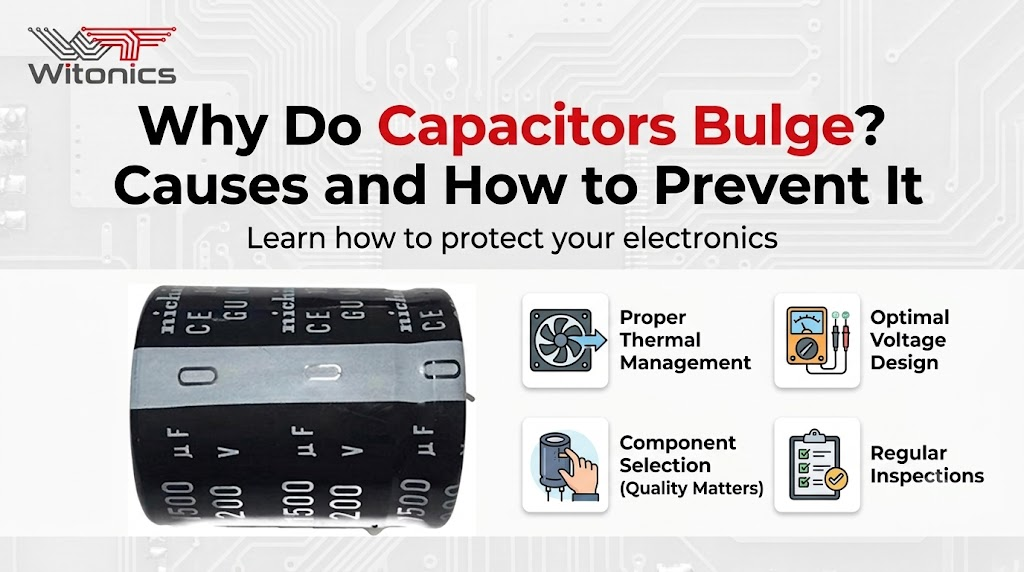

If you've ever opened up a TV, monitor, or power supply and noticed a capacitor with a domed, swollen top instead of a flat one, you've found your problem before you even ran a single test.
A bulging capacitor is one of the clearest visual signs of failure in electronics, and it's also one of the easiest to miss if you don't know what you're looking for.
Here's what actually causes a capacitor to bulge, why it matters, and what you can do to stop it from happening again.
Mostelectrolytic capacitorshave small pre-scored vent lines stamped into the top, usually in a K, X, or + pattern. On a healthy capacitor, that top is flat.
On a failing one, internal pressure pushes that top upward into a dome shape, sometimes cracking along the vent lines. In more advanced cases, you'll see dried electrolyte residue crusted around the base, or the capacitor may be visibly leaning.
If you spot this on a circuit board, it's not a maybe; it's a component that needs to be replaced.

Acapacitor bulges because gas is building up faster than it can safely escape, and that almost always comes down to one of a few root causes.
Heat is the biggest one. Electrolytic capacitors are rated for a specific temperature, and every 10°C above that rating can cut their working lifespan roughly in half.
Capacitors placed near power transformers, heat sinks, or in poorly ventilated equipment age much faster than they should.
Age plays a role too. The electrolyte inside naturally dries out over years of use, especially in devices that run for long stretches, TVs, monitors, and power supplies included.
This is a slow, normal process, but it eventually causes the same internal pressure buildup as heat damage.
Excessive ripple current is another common cause, particularly in power supply and motherboard capacitors. If a capacitor is asked to handle more electrical ripple than it's rated for, it heats up internally and degrades faster than its rated lifespan suggests.
No. A bulging capacitor has already started to fail internally, even if the device still technically powers on. Left in place, it will keep losing capacitance, which shows up as flickering screens, clicking noises, slow startup, or a device that eventually won't power on at all. In rare cases, a capacitor under enough pressure can vent electrolyte or, less commonly, split open. It's not a component worth waiting on.
Prevention mostly comes down to matching the replacement capacitor correctly and giving it a fair environment to work in.
→Always match voltage rating, capacitance, and temperature rating to the original part, and don't be tempted to go lower on any of these specs just because it fits.
→Where possible, choosing a capacitor rated for 105°C instead of 85°C gives meaningfully more headroom in warmer enclosures.
→Sourcing capacitors from trusted manufacturers also matters more than it seems; ourcapacitor collection uses trusted names like Nichicon, Rubycon, and Panasonic specifically because capacitor quality has a direct, measurable effect on how long a repair actually lasts.
If you're not sure which capacitor matches your board, our guide onhow to choose the right capacitor for your project walks through reading the markings correctly before you order a replacement.
And if bulging isn't the only symptom you're seeing,top 5 signs your capacitor needs replacement cover the other warning signs worth checking for at the same time.
Q: Can a bulging capacitor be fixed instead of replaced?
A: No. Once a capacitor bulges, the internal damage is permanent. Replacement is the only reliable fix.
Q: Is it dangerous to touch a bulging capacitor?
A: It can still hold a charge, so always discharge it safely before handling, and avoid touching the vent area directly.
Q: How long can a device run with a bulging capacitor?
A: There's no safe timeline. Performance typically gets worse quickly, and continuing to run the device risks further board damage.
Q: Do all capacitors bulge the same way?
A: No. The vent pattern and bulge severity can vary by brand and size, but any doming or cracking at the top is a failure sign.
Q: Can better airflow really extend capacitor life?
A: Yes. Since heat is the leading cause of premature capacitor failure, improving ventilation around hot components can add meaningful years to their lifespan.
A bulging capacitor is often a sign that something has been putting extra stress on the component, whether that is heat, age, or excessive ripple current.
Replacing it is only part of the fix; choosing the right specifications and allowing enough ventilation can help prevent the same issue from returning.
Witonics stocks capacitors specifically chosen to hold up under real-world heat and ripple conditions because a bulging cap almost always traces back to a part that was never built to handle the job it was given in the first place.