Your Cart is Empty


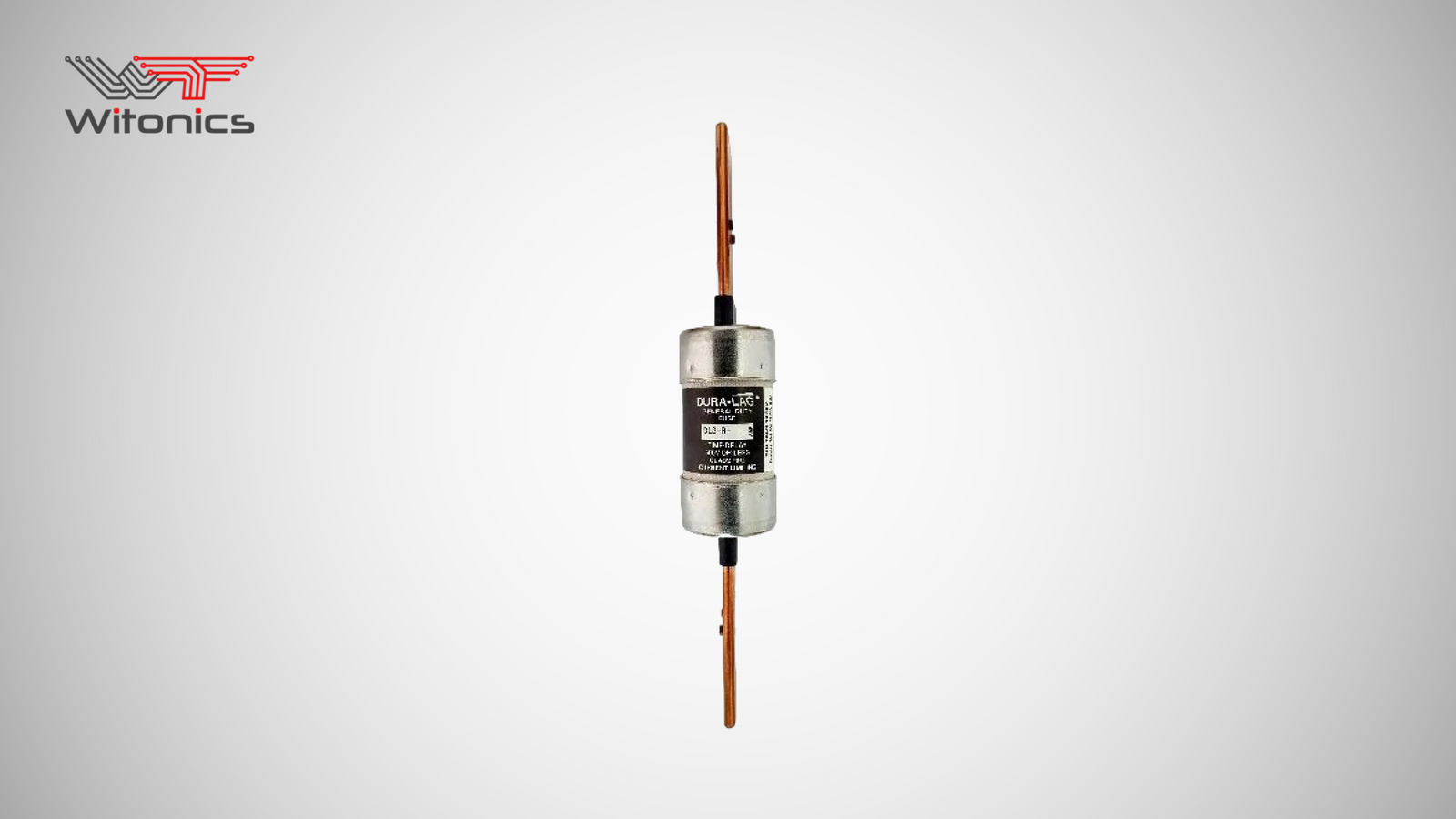

If your fuse keeps blowing the moment you start up your AC unit, pump, or compressor, the problem probably is not the fuse amp rating. It is the fuse type. You likely need a time-delay fuse.
A time-delay fuse - also called a slow blow fuse, slow blowing fuse, time delayed fuse, or slo-blo fuse - is designed to tolerate a brief surge of overcurrent without blowing. This makes it ideal for any equipment that draws a large initial rush of current at startup, then settles back to normal operating levels.
In this guide we cover what a time-delay fuse is, how it works, when you need one, which Bussmann fuse series to use, and how to pick the right size.
A time-delay fuse is a dual-element fuse. Inside, it has two separate protection mechanisms working together:
A fast-blow element that reacts immediately to a true short circuit
A thermal delay element - a spring soldered to the fuse wire - that absorbs temporary overloads without opening
When current spikes briefly (like during a motor startup), the thermal element absorbs the heat. If the spike resolves quickly, the fuse survives it. Only when the overloadpersists does the solder joint melt and open the circuit.
Standard Bussmann Class CC time-delay fuses like the FNQ-R are rated to handle200% of their rated current for up to 12 seconds - enough to ride through motor inrush current - while still providing fast protection against short circuits.
You will see time-delay fuses marked with a"T","TD", or"D" on the fuse body or end cap. The marking "F" means fast-acting. Never confuse the two.
Time-delay (slow-blow) fuses and fast-acting (fast-blow) fuses are not interchangeable. A fast-acting fuse will blow every time a motor starts because it cannot ride through inrush current. A slow-blow fuse on sensitive electronics will allow damaging overcurrent to persist too long before it opens.
The core rule: use time-delay for inductive loads (motors, transformers, HVAC) and fast-acting for sensitive electronics (PCBs, meters, instrumentation). For a full side-by-side breakdown of response times, I2t ratings, and real-world scenarios, see our dedicated guide:Slow-Blow vs. Fast-Blow Fuses - What Happens When You Use the Wrong Type.
Use a time-delay fuse whenever your circuit includes equipment that draws a high inrush current on startup. Here are the most common applications:
Atime-delay fuse for motor circuits is the standard choice because electric motors draw 6-8 times their normal running current for the first few seconds at startup. A fast-acting fuse will blow every single time. A time-delay fuse absorbs that inrush and only trips on a real, sustained fault.
A time-delay fuse for air conditioner and HVAC equipment is commonly required because compressor startup surges are high and brief. Under NEC Article 440, you must follow the equipment manufacturer nameplate - if it specifies a time-delay fuse, that is what the disconnect must use. If your AC keeps blowing fuses at startup, a standard fuse is the wrong tool.
Small control transformers in industrial panels draw very high inrush currents - typically 8-12 times their rated current for the first few cycles of power. The Bussmann FNQ-R is specifically designed and rated for this application.
Any pump motor has the same inrush characteristic as an industrial motor. Time-delay fuses prevent nuisance trips when the pump kicks on, while still protecting against locked-rotor faults.
Compressor-based appliances cycle on and off repeatedly throughout the day. Each startup generates a current surge. A time-delay fuse handles this without wearing out prematurely the way a fast-acting fuse would.

Bussmann (Eaton) makes the most widely used Class CC time-delay fuse options in North America. Three series cover the majority of time-delay applications and are stocked at Witonics:
The FNQ-R is a current-limiting, time-delay, dual-element Class CC fuse rated at 600V AC / 300V DC. It provides a 12-second delay at 200% of rated current, making it the go-to choice for control transformer protection, small motor branch circuits, and industrial control panels. Its rejection design prevents accidentally installing a lower-rated supplemental fuse in the same holder.
Ratings: 1/4A-30A, 600Vac, 200kAIC interrupt rating
Best for: control transformers, small motors, branch circuit protection
The FNQ is a supplemental (not branch-circuit rated) time-delay midget fuse for use in control panels and instrumentation. It fits the same 13/32 x 1-1/2 inch midget holder as the FNQ-R but is not interchangeable for branch circuit protection.
Ratings: 1/10A-30A, 500Vac
Best for: control panels, instrumentation, secondary protection
The KTK-R is a fast-acting Class CC fuse often paired alongside time-delay fuses in industrial control circuits for semiconductor protection. The KTK series provides supplemental protection in the same midget size. Always confirm whether your application calls for fast-acting or time-delay before selecting between KTK and FNQ-R.
Ratings: 1/10A-30A, 600Vac
Best for: semiconductor protection, control circuits requiring fast response

Three specifications must match your circuit:
Amperage - match to the equipment Full Load Amps (FLA) shown on the nameplate. Per NEC 430.52, motor branch circuits allow up to 175% of FLA with a time-delay fuse. A practical starting point: FLA x 1.25 for most applications.
Voltage - always meet or exceed the circuit voltage. A 600V fuse is safe on 120V, 240V, or 480V circuits. Never use a fuse rated below circuit voltage.
Class - branch circuit protection requires Class CC (FNQ-R or KTK-R). Supplemental protection inside a panel uses FNQ or KTK. Do not use a supplemental fuse as the only branch circuit protection.
Quick rule:Check the nameplate FLA, multiply by 1.25, round up to the nearest standard amp size, and select a 600V Class CC time-delay fuse.
When replacing a blown fuse, the markings on the fuse body tell you exactly what to match:
|
Marking |
Meaning |
Example |
|---|---|---|
|
T or TD |
Time-Delay / Slow Blow |
FNQ-R-10 (10A time-delay) |
|
F |
Fast-Acting |
KTK-R-10 (fast-acting Class CC) |
|
D |
Delay (alternate marking) |
Seen on older glass tube fuses |
|
TM |
Time-Delay Miniature |
Small format supplemental fuses |
Always match the marking exactly when replacing. If the original fuse was marked"T", your replacement must also be time-delay. Installing a fast-acting fuse (marked"F") in its place will cause nuisance blowing or expose inrush-sensitive equipment to repeated fast trips that stress the circuit.
Yes - exactly the same thing. Slow blow, time-delay, slo-blo, slow blowing fuse, anti-surge, and T-rated fuse all refer to the same type: a fuse with a built-in delay that tolerates brief overcurrent surges before opening. The different names are used by different manufacturers and regions, but the electrical behavior is identical.
No - they are not interchangeable. Swapping types causes nuisance blowing, equipment damage, or inadequate protection depending on which direction you swap. We cover every scenario in detail in our guide:Slow-Blow vs. Fast-Blow Fuses - What Happens When You Use the Wrong Type (link in the section above).
The 'T' marking stands for Time-Delay (also written as 'TD'). It indicates the fuse has a delayed response to overcurrent - it will tolerate a brief surge without blowing, but will open on a sustained overload. You will find this marking printed on the fuse body or stamped on the end cap.
If your current fuse blows at startup but the equipment runs fine once it is going, you almost certainly need a time-delay fuse. Any circuit with a motor, compressor, transformer, or pump will have inrush current at startup. Check the equipment nameplate - if it lists LRA (Locked Rotor Amps) or Inrush Amps significantly higher than the FLA (Full Load Amps), a time-delay fuse is the right choice.
Both are Bussmann time-delay midget fuses, but they serve different purposes. The FNQ-R is a Class CC branch-circuit rated fuse (600V, 200kAIC) for main protection in branch circuits and panel feeders. The FNQ is a supplemental fuse (500V, lower interrupting rating) for secondary protection inside control panels and equipment enclosures. Use FNQ-R for branch circuit protection and FNQ for supplemental protection inside equipment.
A time-delay fuse is not just a slower version of a regular fuse. It is a precision-engineered component designed to match the electrical behavior of motors, compressors, transformers, and other inductive loads. Using the wrong type costs you blown fuses, nuisance downtime, and potential equipment damage.
Witonics stocks the full Bussmann time-delay lineup - FNQ-R, FNQ, and KTK - in a wide range of amp ratings and ready to ship. Browse ourfull fuse collection or use the sizing guide above to find the exact fuse your application needs.